
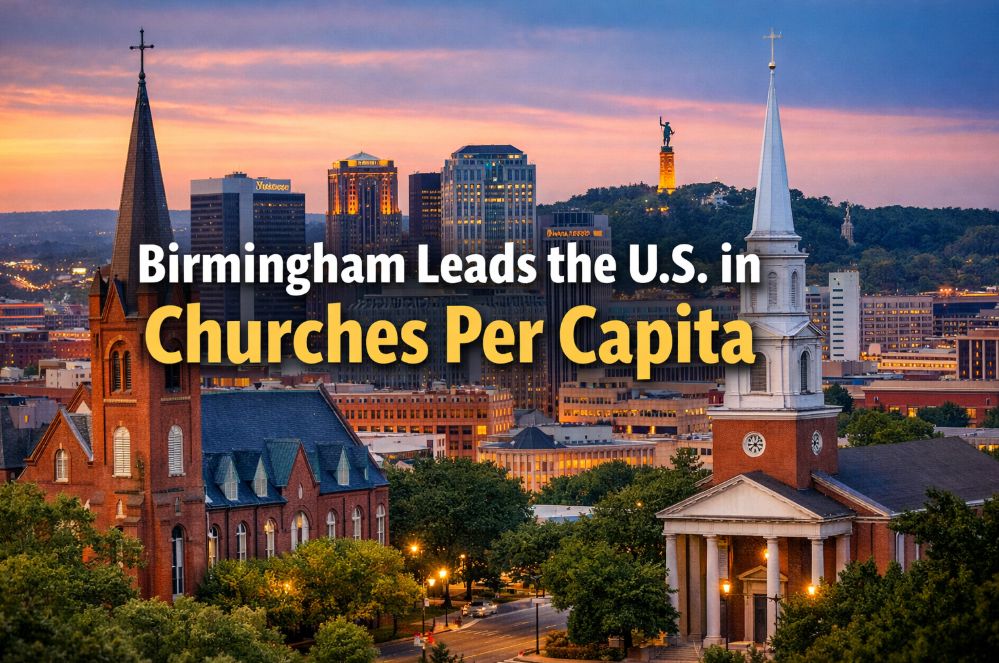
The city of Birmingham, Alabama, occupies a special place in the history of American religion and culture. Known as a city with long-established traditions, close community bonds, and a history of involvement in the Civil Rights Movement, Birmingham has also earned a reputation for having an impressive number of churches per capita. To local people, faith-based organizations are not only worship but communities, cultural hubs and networks of social support. Even current digital sites, such as WP-1Click, are targeting churches and ministries in places like Birmingham, demonstrating how the faith community continues to evolve while remaining central to everyday life.
This paper will discuss the reasons, how, and why Birmingham has the most churches per capita in the United States and what it means to the city presently. The discussion is structured in a way that is easy, understandable and informative to all types of readers.
Understanding Churches Per Capita
It is necessary to get familiar with the actual and precise meaning of churches per capita before getting into details. The concept is the number of churches in a city divided by the number of residents there. A city that has many churches per capita is not always the one that contains the largest population or even the highest number of churches. Rather, it has a high population of churches in proportion to its size.
In the case of Birmingham, the city lacks the comparison with big cities such as New York or Los Angeles in terms of population. Nevertheless, counting the number of churches against the number of residents, Birmingham always shines through. This ratio brings out the extent to which faith-based institutions are interwoven into daily life.
A Brief Historical Context of Faith in Birmingham
Religion has played a central role in Birmingham’s development since its founding in the late 19th century. The city grew rapidly as an industrial hub, attracting workers from rural areas across the South. Many of these newcomers brought strong religious traditions with them, particularly Protestant Christian denominations.
Churches became more than spiritual spaces. They were places where families gathered, newcomers found support, and communities formed identities. During the Civil Rights Movement, Birmingham’s churches were especially significant. Many served as meeting points for activists, organizers, and leaders. This history further cemented the church as a trusted and respected institution within the city.
Over time, instead of consolidating into fewer, larger churches, Birmingham saw the formation of many small and mid-sized congregations. This pattern contributed directly to the high number of churches per capita seen today.
Cultural Factors Behind Birmingham’s Church Density
Culture plays a major role in shaping Birmingham’s religious landscape. The city is part of the American South, often referred to as the “Bible Belt.” In this region, church attendance and religious involvement have traditionally been higher than in many other parts of the country.
In Birmingham, churches often reflect neighborhood identities. It is common for a single community to host several churches, sometimes even on the same street. Each church may serve a slightly different congregation, denomination, or worship style. This diversity allows residents to choose a church that closely aligns with their beliefs and preferences.
Family traditions also matter. Many people attend the same church as their parents or grandparents, while others start new congregations when their spiritual needs change. Over generations, this has led to a steady increase in the number of churches rather than a reduction.
Demographics and Denominational Diversity
Another reason Birmingham stands out is the wide range of Christian denominations represented within the city. While Baptist churches are especially common, there are also Methodist, Pentecostal, Presbyterian, Catholic, Episcopal, and non-denominational congregations.
In addition to Christian churches, Birmingham is home to other faith communities, including synagogues and mosques. While these are fewer in number compared to Christian churches, they contribute to the city’s overall religious richness.
This diversity means that churches often remain relatively small and focused, serving specific communities or traditions. Instead of one large church replacing several smaller ones, Birmingham continues to support many individual congregations.
Birmingham Compared to Other Major U.S. Cities
To better understand Birmingham’s position, it helps to compare it with other cities. The table below provides a simplified comparison of church density in selected U.S. cities. These figures are illustrative and based on commonly cited trends rather than exact counts.
| City | Approximate Population | Estimated Number of Churches | Churches Per Capita (Relative) |
| Birmingham, AL | ~200,000 | 1,200+ | Very High |
| Nashville, TN | ~700,000 | 1,500+ | High |
| Atlanta, GA | ~500,000 | 1,000+ | Moderate |
| Dallas, TX | ~1,300,000 | 1,600+ | Lower |
| New York City, NY | ~8,000,000 | 3,000+ | Very Low |
This comparison shows why Birmingham is often highlighted as a U.S. city with most churches when measured per capita rather than by total numbers.
The Role of Churches in Modern Birmingham
Today, churches in Birmingham continue to play a wide range of roles beyond worship services. Many operate food banks, provide counseling services, support youth programs, and host community events. For some neighborhoods, the local church is the most stable and consistent institution available.
Churches also serve as places of connection in an increasingly digital world. While online platforms and social media are widely used, in-person gatherings remain important for building trust and maintaining relationships. Birmingham’s church density makes it easier for residents to find nearby support and engagement.
At the same time, many churches are adapting to modern expectations. They maintain websites, stream services online, and use digital tools to communicate with members. This blend of tradition and innovation helps them remain relevant.
Economic and Social Impact on the City
The presence of so many churches has a noticeable impact on Birmingham’s economy and social structure. Churches employ staff, contract local services, and host events that bring people together. Weddings, funerals, conferences, and festivals often take place in church facilities, contributing to local businesses.
Socially, churches often act as first responders in times of crisis. Whether during natural disasters, economic downturns, or public health emergencies, churches frequently organize relief efforts. Their deep roots in local communities allow them to respond quickly and effectively.
This widespread presence also means that churches often collaborate. Interfaith and interdenominational partnerships are common in Birmingham, especially around social justice and community development initiatives.
Challenges of Having So Many Churches
While Birmingham’s high number of churches is often viewed positively, it does come with challenges. Some congregations struggle with declining attendance, aging membership, or limited financial resources. Maintaining historic church buildings can also be expensive.
In certain areas, multiple small churches may compete for the same pool of attendees. This can make long-term sustainability difficult. As demographics shift and younger generations approach faith differently, churches are being forced to rethink their outreach strategies.
However, these challenges have also sparked creativity. Many churches are merging, sharing resources, or redefining their missions to better serve modern communities.
Why This Matters Beyond Birmingham
Birmingham’s example offers insight into how faith shapes cities across the United States. While not every city has the same religious density, the relationship between culture, history, and community institutions is universal.
Understanding why Birmingham leads the nation in churches per capita helps explain broader patterns in American society. It highlights the importance of local traditions, the lasting influence of history, and the role of community-centered institutions in shaping urban life.
For researchers, city planners, and faith leaders, Birmingham serves as a case study in how religious organizations can remain influential even as society changes.
Looking Ahead: The Future of Churches in Birmingham
The future Birmingham churches will impose on the churches of the city is likely to be a compromise between preservation and adaptation. Older congregations will still stick to old traditions, and newer ones will experiment with types of worship and methods of outreach.
Technology will become more and more significant but personal connection will be kept in mind. The church in Birmingham will not soon fade away as long as it continues addressing the actual needs of the community.
The fact that the city boasts the highest concentration of churches is not merely a statistic. It is a living, breathing network of institutions that are still defining Birmingham.
Final Thoughts
The fact that Birmingham has led in the number of churches per-capita is the culmination of history and culture and a community value system that has been a product of generations. The churches in the city are not just buildings; they are also social areas, support networks and beacons of continuity.
The churches in the city of Birmingham will keep evolving as the city progresses without losing its main objective. They are ingrained in the city, whether with the help of community service, spiritual guidance, or digital outreach. If you are involved in church leadership or planning a digital presence for a ministry, choosing the best church website builder can be an important step in connecting with today’s audiences while honoring long-standing traditions.
Leave a Reply